The iconic adventurer is a person outside of society. They follow no lord. They essentially rob tombs. They are judge, jury and executioner (no adventurer has ever brought an orc to trial). They wander from town to town, becoming a part of nothing.
Society likewise mistrusts the adventurer for making the choice to live outside the norms. Adventurers are not to be trusted; after all they have no vested interest in the community. They have made a choice that is an aberration. Adventurers are here today and gone tomorrow, and if the stories spread around are true, they are gone with something of value to the community.
What if we turned this stereotype and cliché on its head? What if instead they were a part of society? What if they were the same as a baker or blacksmith in the eyes of society; where being an adventurer is just another occupation? That is how I am running it in one of my current campaigns. In this society, adventurers are looked favorably upon and have been integrated into the customs and societal norms.
May 31, 2011
May 27, 2011
Grapple-How I Loathe Thee
Grapple is one of those sub-systems that too many RPG games feel inclined to include in their rule set. D&D is the poster child of everything ever wrong with Grapple. (Why is Grapple capitalized? Because in my mind it is a proper noun and thus I can direct all my hatred upon it much the same way I can with any person I also have hatred for.) When it was first introduced as an option its rules were clunky, cumbersome and more of a hindrance than a help. It has been this way through multiple editions as it subtly and not so subtly changed in each edition. In 30+ years of RPG gaming I have never used any system’s Grapple rules.
(Begrudgingly, I will admit that I do in fact use the grappling rules for 4E, but I will also contend that grapple in 4E is different enough from the standard concepts of Grapple in every other game that uses it. All grapple does in 4E is immobilize the opponent, much the same way many, many other powers in 4E do. It does not render an opponent unable to act as Grapple does in so many other systems.)
What is Grapple good for? Nothing! Some will contend it adds another layer of simulation to combat. I say hogwash! The act of grappling is part of the 6 second fight. The majority of RPG rule systems abstract a round of combat wherein a single attack roll is not in fact a single swing or punch. Instead it is a series of punches and blows that culminate in an overall effect distilled down into a single die roll. I contend the act of Grapple is a part of this series of fisticuffs.
Take a look at cinematic fight scenes. Often there are measures of Grapple taking place during them. One opponent tries to grab another and the other punches him in the face to elude the Grapple and thus the fight goes back and forth. The actual effect of the Grapple, gaining control over your opponent so that he is incapable of doing anything, actually happens after a prolonged series of attacks and counterattacks. In RPG terms the opponent is down to 0, or lower, hit points. It is not a case of the opponent suddenly making his Grapple roll; it is more a case where the opponent wore down his target (loss of hit points) until the target was rendered incapable of further action. Grapple is less of a single attack type and more an end result of combat itself.
Grapple should only be used as a descriptive term. This would be much in the same way a fight is described with punches, swings, kicks, elbows to the face, etc; Grapple is just another expression similar to all of those.
Why do players even want a Grapple rule? It allows them to remove an opponent from a fight before the loss of their hit point pool (or levels of injury or whatever system that simulates hit points). It is a way to circumvent the standard fight mechanics, a short cut to the end. In effect, they are trying to cheat the system.
So, no, I do not allow for formal Grapple rules in the games I run (other than 4E). I find it is not worth it. How do you feel about Grapple? Are there other game sub-systems that are a part of many RPG rule sets that you despise?
May 26, 2011
A Question for Grognards about Early D&D
Despite playing D&D and other RPG games for over 30 years, I do not know much of the history of the game; I just play to play. However, the other day I was doing some thinking about the TPK (total party kill) and it suddenly struck me. How did the early player characters of D&D survive? Likely I am looking at this through skewed perceptions but my understanding of D&D is that in the early days of the game TPK were the norm, something to be expected and accepted.
So my question is, how did the likes of Tenser, Mordenkainen, Drawmij, Robilar, Terik, Murlynd, Melf all survive to reach high levels? These are some names that have been with us throughout much of the history of D&D, adding spell names and magic items to the lexicon of D&D, but at one point all of these were player characters facing the exact same challenges every other player character was facing at the time.
Heck, Tenser was created as one of the first two player characters ever created for the game that would be D&D. Robilar, Terik, Murlynd were all created at the second ever session of D&D (the day after the first game session). And yet, those characters managed to survive past level 1 and in fact made it all the way until they retired at high levels. I mean its easy enough to kill a character at 1st level but it doesn't get much easier after that. One inescapable trap, one unbalanced fight and the character is dead. And this is onoging over many levels. So, with all the talk of TPK how did they manage it?
I could speculate. Perhaps the players back then were cleverer than the ordinary person, perhaps the DMs were softer back then, perhaps they were being run through playtest dungeons and were thus facing weaker opposition, perhaps the TPK of early days has been exaggerated, perhaps these are the only ones to have survived the deaths of hundreds of other characters of the same time period, perhaps death was more of an inconvenience and resurrections were readily available. Honestly I don’t know and speculation is not an answer. I would be curious to hear from those who are familiar with the game play of those first days.
In an age said to be rife with TPKs, how did those early player characters survive to high levels?
May 24, 2011
The Small Huge Dungeon
When we envision the mega-dungeon, or even a large sized dungeon we picture a series of corridors leading off to wings of rooms. Corridor leads to corridor as the party explores through a system of rooms each with their own purpose. This makes for an epic place for adventure, but after a while it can grow a bit tedious. There are some inherent problems with the typical large dungeon.
May 22, 2011
D&D's New Direction is Horrible!
What is up with this new direction D&D is taking?! I want to role-play, I want an adventure where my hero can shine! Instead the newest adventure module is all about putting my character into impossible situations, all in an effort to challenge me! I don't want to be challenged at the peak of my character's abilities. I want to role-play with the merchant as we haggle for a savings of 2 silver pieces. I want to rescue the king's daughter from the kobolds so I can become a prince.
What I do not want to do is run through a dungeon crawl whose only intent is to run through the dungeon crawl. I mean what's the point of that?! The only success is success. There is no story in this except to kill the end boss guy. Personally I don't like this type of adventure and I certainly don't like what it is teaching our new players. They will begin to think D&D is about nothing but dungeon crawls and dungeon challenges. They will NEVER learn about stories and plots and adventures with lofty goals. Because of this one adventure, D&D is forever destroyed for me.
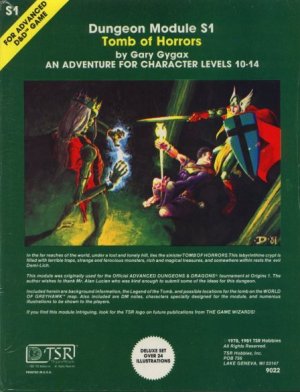
Unless you've been hiding under a rock for the past 36 years then you know I am talking about the Tomb of Horrors (1975 version). In Gary Gygax's, the author of this "adventure", own words, "There were several very expert players in my campaign, and this was meant as yet another challenge to their skill—and the persistence of their theretofore-invincible characters. Second, so that he was "ready for those fans [players] who boasted of having mighty PCs able to best any challenge offered by the AD&D game."
Now I am not one to buy into hyperbole and spread viscious words around all based on a couple of sections of advertisement blurbs, so I went out and actually got it and read it. That way you can trust my analysis as it is something I have actually seen. And let me tell you, it is out-of-control! They were not kidding. If you don't bring in your top notch character all decked out with the best selection of gear and spells, you won't last more than a few seconds. It seems like you'll need all the latest supplements in order to survive this fiasco. Yet another method by which TSR is trying to drag more money out of us!
Even worse, I hear this is only the first a series, the "S" series of adventure modules. S2 is purported to be named White Plume Mountain to be followed by S3: Expedition to the Barrier Peaks. From this we can easily see where D&D is heading and it is heading off somewhere I do not like! D&D is dead to me and I recommend everyone else on the planet get off that train wreck with me!
Subscribe to:
Posts (Atom)