Showing posts with label Dungeon Masters. Show all posts

July 7, 2015

5E Traps - Samples and A Better Design

I am not happy with the layouts of WotC's traps. Basically there is none. They jumble the information about a trap into a couple of paragraphs that a DM has to sift through to get the relevant info. I prefer something I can easily look at and immediately find what I need.

I've been writing an adventure for my group that is laden with traps (it is a kobold lair). I came up with another layout/design for traps that work better for me and maybe better for other people. Here are the traps so you can see the layout and if you are looking for some more traps to use... 

Tar Trap
See Trap: DC14 Wisdom (Perception). “The floor feels weakened here.” 
Disable Trap: DC15 Wisdom (Perception) to move across the trapped area without setting off the trap. Roll with advantage if the person watches someone else cross safely. “There are parts of the floor that are still safe. The trick is to figure out where exactly that is.” 
Activates: When someone moves near the center of the trap area. “The floor gives way.” 
Set Off Trap: Anyone in the trap area is Restrained. A person may take an action to make a DC 12 Strength Save to end the Restrained condition and move out of the trap area. “You fall all of 3 inches. However, those three inches are covered in an odorless tar and your feet are stuck.” 

Leech Pit
See Trap: DC12 Wisdom (Perception). “There is something wrong with the floor up ahead. In fact, you swear you can make out where a corner of the floor is lifted up.” 
Disable Trap: DC15 Dexterity. “The floor is in fact nothing but a loose cover for a pit. You think you can make it so it will not collapse when walked on.” 
Activates: When a person moves to the halfway point. “The floor falls out from under your feet revealing a pit beneath you.” 
Set Off Trap: Everyone in the area of the trap must make a DC12 Dexterity Save. Failure means the person takes 1d6 falling damage and is now in a 10’ deep pit. In addition, the pit is filled with leeches. Each round the person takes 1d4 damage from the many leeches on them. Once out of the pit they can spend an action to remove the leeches. “You fall to the bottom of the pit which is covered in rotten meat, a couple of carcasses and hundreds of leeches. The leeches quickly latch onto you.” 

Stinkbomb Trap
See Trap: DC18 Wisdom (Perception). “There is a tripwire low to the floor. There is something odd about the ceiling.”
Disable Trap: DC15 Dexterity. “Any movement of the tripwire will set off the trap. A wedge needs to be placed where the wire enters the walls so when the wire is cut they will not release tension.”
Activates: When a person moves to the end of the trap and trips the wire. “You feel the pull of a tripwire.”
Set Off Trap: Everyone in the trap area must make a DC12 Dexterity Save. Those that fail are covered in a liquid that gives off a strong musky smell. At the same time the giant weasels from location 6 move to the smell and attack, focusing their attacks on those covered in the scent. “Parts of the ceiling collapse revealing bags that fall to the ground and burst. The bags were filled with a liquid that now covers you. The liquid seems to be water and does not harm you other than leaving a bad smell.” 

Collapsing Ladder Trap
See Trap: DC14 Wisdom (Perception). “The ladder looks shoddy and not safe.”
Disable Trap: None, ladder is fake and cannot be used as a ladder. “The ladder is designed to collapse. It is best left alone.”
Activates: When a person climbs up the ladder and is near the top. “The next rung suddenly gives way as the ladder itself falls apart.”
Set Off Trap: Entire ladder collapses and the climber takes 2d6 falling damage. “The entire ladder comes off the wall in pieces. You plummet to the floor.” 

Deadfall Trap
See Trap: DC12 Wisdom (Perception). “The ceiling looks loose. There is a string stretched across the tunnel.”
Disable Trap: DC15 Dexterity. “Cutting the string will release the tension and disable the trap, but be careful as tugging on the string will activate it.”
Activates: When a person moves into the end of the tunnel without seeing the trap. “Your foot pulls on a tripwire near the floor.”
Set Off Trap: 1d10 damage to everyone within 10’ of the end of the tunnel; DC15 Dexterity Save for half damage; makes a loud noise alerting location 4. “The roof comes cascading down with a loud series of crashes.” 

Pit Trap
See Trap: DC12 Wisdom (Perception). “The floor ahead looks unsafe.”
Disable Trap: DC15 Dexterity. “By wedging a small item into the seam where the pit and regular floor meet it should be safe to walk over one at a time.”
Activates: Move to the end of the northern end of the trap. “The floor tilts downward and then collapses.”
Set Off Trap: Everyone in the trap’s area must make a DC12 Dexterity Save. Those that fail take 1d6 falling damage and are now in a 10’ deep pit. “You fall into a 10’ deep pit.”


April 7, 2015

I Hate the Game I'm Running, But My Players Won't Let Me Stop

I hate the game I am running. Right now I am running Shadowrun (third edition). I love Shadowrun but I hate being the GM. I can never figure out that delicate balance between challenging the players and letting them walk all over the opposition. Part of me realizes that Shadowrun is a munch-kin game designed for min-maxers who want nothing more than to stomp all over everything in their way. I realize that but still try hard to challenge them. I have been able to instill a fear of the unknown, but they still walk all over everything they actually meet.

But then we have nights where the mage goes unconscious in one hit (his own fault for not using a Karma point to re-roll all of his failures) and at the end of the night he says he had a horrible time being out of the action for the entire night. I calculated the odds and figured he could easily survive the hit. My bad. But it is frustrating.

And then we have last week. They are investigating a series of murders and at the end of the night they realized they hadn't rolled a single die. They ended the night by saying they had a great time.

And the week before. This time one of the players mentioned he really appreciated the fact that we've been playing Shadowrun long enough that he could actually upgrade some cyberware for his character. He said this is something he has never been able to do before in a Shadworun game. This is coming from someone who has played in multiple Shadowrun games since it was first released in 1989. All of his other campaigns ended before they could gain enough nuyen/karma to reach their goals (and I've actually been rather stingy with nuyen/karma - mostly because I forget to hand them out).

So, I guess for now I'm sticking it out. I have not yet reached the table-tossing level of running Shadowrun. I may not like it, but my players do...and the players are the important ones.

March 24, 2015

Failure from Success

Players hate to fail. They hate it even more if it seems like they were set up to fail. And yet, sometimes a DM will write an adventure when they are supposed to fail (get captured, let the bad guy get away, etc). However, there is a way for the players to fail without it feeling like a failure...and that is to give them a rousing success that includes the failure going off as a side effect.

As an example, my current Shadowrun campaign started with the player characters being hired to kidnap a mage and hold him for 24 hours. The run went perfectly and they all got paid. A rousing success! However...they soon found out that the victim was working as magical protection for the local mob boss who was killed during that 24 period...and that his heir was a woman who just happened to be dating one of the runners. The fallout is ongoing for that "success".

I could have used a heavy handed tactic to force the players into their predicament. After all, I needed the PCs to be in their current situation for the story and plot to advance. However, I "forced" them into it with a success, not a failure on their part. This concept can be used in almost any plot angle...

-The plot calls for the princess to die so a war can start between two nations. Instead of having the PCs fail to save the princess before she is killed, the PCs can rescue her but in the process they discover she has been a doppelganger working for the enemy nation for years. The PCs still succeed but the "failure" of their discovery starts a war nevertheless.

-The PCs attack an orc stronghold in a mountain pass that has been plaguing a region....only to discover that with the orcs dead the pass is now open to an invading army of barbarians. Instead of having the PCs fail to keep the mountain pass closed to the barbarians, they succeed by killing the orcs...with the end result being what the DM wanted - an invasion campaign.

It's okay to sometimes force something to happen to keep a plotline going, but it doesn't have to require the player characters failing at something to accomplish it.

March 10, 2015

Power in a Vacuum

In most campaigns the DM has the general area and antagonists already outlined. "Kill some kobolds then move on to the temple with the undead." The enemy is often unnamed and ultimately of low consequence. Kobolds are plentiful and if for some reason the party fails to kill them the world will not end. Monsters tend to be generic, and if they have a name, no one in the world cares except for those living next door.

But as a campaign gets older the antagonists become more powerful to properly challenge the players. And it is at this point that some campaigns falter in the area of "believability". If the newest enemy is the OrcKing and his army of 100,000 Trolls, one of the first questions the players will ask is "why haven't we heard of this guy before?" "With an army that big where was he hiding for the past 2 years?" These sorts of questions will jar the players out of the immersion of play.

The more powerful an enemy is, the more world-wide recognition and impact they would have.

The trick is to feed the names of these powerful individuals and organizations to the players early in the campaign instead of having them leap out in surprise. This is easy to do if you know who the end-game enemy will be. You can slip their names out in passing..."The LichKing rules the North so no one ever goes there." "Thousands of trolls occupy MudFen so it's best to avoid that area."
 
However, sometimes a DM has not worked out all the details of his world yet. They may not know who the bad guy will be later in the campaign. That is okay. The trick here is to insert random names. Sure they will have no meaning now, but they will be available for later usage. Consider them placeholders. Examples are...the Crimson Divide, Cabal of Four, The Black Monk. You may not know what any of those are, but in a later adventure, at higher level, you can pull them out. The players will be already familiar with the name, even if they don't know the details.

One caveat to this article is that...sometimes it is okay to have an organization or powerful individual come at the players from out of nowhere, out of a vacuum. This especially works well for secretive type of groups such as secret police or hidden cults imbedded in the normal population. There the whole point is secrecy and for the players it makes sense to not have heard of them before.

But for big, world impacting power groups, get the word out early.

May 20, 2014

The Flashback "We Are Down Players" Adventure

Last week was the second play session of our new Shadowrun (3rd edition) campaign. It is the initial stages of the plotline and for story purposes, and player buy-in, I need all my players to show up for the first few adventures. Last week I was down two players, one was having a baby and the other was visiting his father in the hospital. I still wanted to run something as a campaign can die if the "new campaign momentum" stops.

So, I ran a flashback adventure.

This was run as a singular run with only the table-present players participating. The characters of the missing players were "out drinking and couldn't be reached in time". The adventure was presented as something that happened early in the character's career, a few months before the start of the current campaign time frame. We were able to finish the adventure within the night so there was no carry over into next week's play. The characters were rewarded with xp and money...which they will keep when the game starts again in "current campaign time". It will be assumed they haven't had a chance to spend the money yet, and xp is a meta spend.

A group can run a flashback adventure and not have it impact too heavily on the "current time" adventures if they are run early enough in the campaign. However, there will come a point where explaining where the characters suddenly got a magic weapon or assault cannon becomes problematic. "Why didn't you use that in adventure X if you had if before adventure X?" At this point it may be too late to run a flashback adventure unless there is nothing the characters can bring forward to the current campaign other than information...and even that may need to be explained.

However, for this one time, it was a good way for my group to adventure within the current campaign even though we had missing players.

May 6, 2014

The Mystery XP

In last weeks Shadowrun game I gave the group 1 Karma (the Shadowrun equivalent of xp) above the normal allotment and simply said, "This is for something Shiva said during tonight's game." I never explained what it was that she said that earned the group the extra xp. I let them figure it out, or wonder about it, themselves.

In this case, she came to the conclusion that the Yakuza were not behind the hit on Seattle's Mafia Don. She used logic (the Yakuza would have chosen a different assassination method) and even explained it in character (she is a shapeshifter tiger and related the assassination to a predator cat killing an enemy for territory). She was indeed spot-on with her statement. So at the end of the night I gave the Mystery XP.

I like to do this on occasion. I like to reward the players when they intuitively do something smart, verging on brilliant. However, I often do not want to come right out and tell them they were right about something. In this case, she was only speculating. Within the game there has been no confirmation that the Yakuza were not involved. So, I instead gave the group a Mystery XP. They quickly determined it was her Yakuza statement that earned them the extra point. I like this place of unspoken confirmation.

Have you ever given out xp without telling the players why they are getting them? Would you ever, or do you think the players should always know why they are getting xp?

April 15, 2014

Reason #18 - Why I Like Published Material

I've already given you my Reason #21 - Why I Like Published Material. Here is another reason why I like them. They keep a DM honest. As a campaign goes on longer and longer, a DM begins to adapt to what the players bring to the game. If they always fly as they move down a corridor in order to avoid any potential traps, I will have the trip wire be placed at flight height. If they always spike shut a door after entering, I create doors that are soft and break when spiked. If the thief always stands on the right side of a potentially trapped door, I make sure to place the trap on the right side of the door. If they like to carry lots of flasks of oil, I make sure my monsters use fire against them.
Of course, this works the other way as well. If I put a stone wall in front of the character's progress, I also make sure they have a means at their disposal that will allow them to bypass that wall. I do not throw a level 25 monster at a level 2 party, unless I also provide a means for their escape.

Even when I don't do it consciously, there are times while creating my own adventures that I alter what the characters encounter based on my knowledge of what the players and their characters are capable of. Using a published module allows for me to run an adventure that was created without prior knowledge of the players and their characters. The characters will then run into things that may be below or above their expertise. If its below then the players can feel more powerful than I would normally allow them; if its above then the world feels more "realistic" and less contrived.

When running a published adventure my personal biases are not part of the equation.

March 11, 2014

4E+WoW Naxxramas (Construct)

A few years ago I had this idea to write up a series of articles detailing how to integrate some of the World of Warcraft encounters into 4E. I never completed it but I figured I'd put up the one article I did finish...

Today we’ll take a look at the Construct Quarter of Naxxramas. The wing consists of four boss encounters, including the PuGKiller, Thaddius.

Patchwerk
This is a fairly straightforward fight; lots of damage fairly fast. It required having well geared tanks and good healers. The main ability of the boss was his large burst damage which targeted those with agro and with high hit points. There are no adds during the fight and as such he should be considered a solo.
His main ability is Hateful Strike. You can replace a monster’s daily or rechargeable ability with this instead.
Here I have taken a standard Ogre Warhulk and reskinned it to incorporate the concepts of the Patchwerk fight.

You will notice that the ogre warwerk is vulnerable to ranged attacks, as its attacks are all melee based. However, its higher than normal speed and reach, should allow it to reach a character and use its melee attacks.


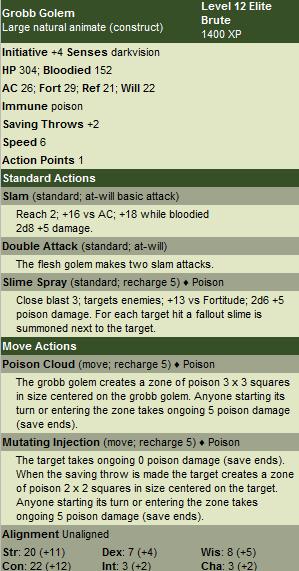
Grobbulus

This encounter contains a few different elements, but essentially boils down to 3 unique abilities:

-Poison Cloud: This is a pool of poison that he drops at his feet. This is excellent for requiring the party to remain mobile.
-Slime Spray: This summons additional monsters (minions) into the fight as it progresses.
-Mutating Injection: This causes a player character to drop a pool of poison at their feet. Again this is useful for keeping the party mobile.

This time I reskinned a Flesh Golem.


The Fallout Slime is a basic minion with no attacks other than its aura. As such it will move to the largest group of enemies.


Gluth

This fight is really about the adds that come with the boss monster. The boss himself is relatively weak, but is still the object of the kill. To simulate the encounter the adds (Zombie Chow) have been given an aura that reduces all damage taken. Gluth himself only has two unique abilites.
This is a reskinned a Cauldron Corpse.


The encounter should consist of 1 glulthdron and 8 zombie chow.
The zombie chow focuses its attacks upon the last person to hit it. This allows for a character or set of characters to "kite" the minions until a decimate happens, whereupon they should be killed quickly. The blue aura is a visual clue of how and when a zombie chow's vulnerability changes. However, unless the characters have been given a clue to the zombie chow's focused attacks they will not know how to deal with this encounter. Thus a clue of some sort should be provided to the players.

Feugen and Stalagg
These two are technically part of the Thaddius encounter but are not required to be part of the same encounter. They could be run as a seperate encounter; in fact it is suggested they be run seperately as the encounter could drain too much from the party's resources otherwise.

The fight starts with the two on seperate platforms over a pool of caustic slime (causes ongoing 10 poison damage (save ends) if someone steps into it). Near the starting point for each monster is a Tesla Coil. Each monster must stay within 5 squares of the nearest Tesla Coil or there is a close burst 30 that does each enemy's bloodied value in damage to the enemy. Each monster will remain within the 5 squares as long as it has someone to melee.


Thaddius
In the original encounter Thaddius was on a platform, which you had to jump onto from a higher platform (where Feugen and Stalagg were positioned). This is not strictly needed for this fight as it is dynamic enough.
This is a reskinned Nightbringer.

January 28, 2014

The Campaign Bible

A Series Bible is a reference document that some screenwriters for TV shows use to keep track of characters, settings and other notes. It actually has two uses. One is when it is used to promote the show before it becomes produced. This use has character notes, interactions and setting details designed to showcase the potential of the show. Second is when a series is in production and things change to the characters and locations and need to be kept track of for future episodes. Obviously, there is a direct parallel between the format of an episodic TV show and an ongoing rpg campaign.

As an example of a series bible let’s take a look back at the old Lone Ranger TV series from the 1950’s. (For the record I am not from the 50’s, but I did see a lot of the show in reruns growing up.)
Here are a few guidelines set down for the series…

-The Lone Ranger is never seen without his mask or a disguise.
-The Lone Ranger always uses perfect grammar and precise speech completely devoid of slang and colloquial phrases, at all times.
-When he has to use guns, The Lone Ranger never shoots to kill, but rather only to disarm his opponent as painlessly as possible.
-Logically, too, The Lone Ranger never wins against hopeless odds; i.e., he is never seen escaping from a barrage of bullets merely by riding into the horizon.
-Names of unsympathetic characters are carefully chosen, never consisting of two names if it can be avoided, to avoid even further vicarious association—more often than not, a single nickname is selected.
-Criminals are never shown in enviable positions of wealth or power, and they never appear as successful or glamorous.

There were also other things such as “Kemosabe” meaning “trusted scout” and the name Tonto meaning “wild one”, which became a part of the regular lexicon of the show, even though neither is a real word…except that tonto means “dumb” in Spanish and his name was changed to Toro in Spanish language versions of the show. They were made up words that the shows writers gave meaning to, much the same way an rpg writer will give meaning to people and places within their own setting.

I do the same thing when I’m designing my own worlds for gaming. I tend to associate a particular race with a specific real-world language. For instance, I might have my dwarves’ language based off of Lithuanian. When naming locations or NPCs the players might meet or know of, I translate a word I want to associate with that person/place into the foreign language. For example, the king of the dwarves might be Rokas Kateras, which means “rock cutter” in Lithuanian. From there I make a note in my “campaign bible”, otherwise known as “campaign notes”, that dwarven names and locations are based off the Lithuanian language.

Having a Campaign Bible allows for greater consistency within a setting/campaign. By tying my dwarves into a specific language I can be consistent in my naming habits. It can be real jarring to have your player characters meet Rokas Kateras and his two sons, Charles and Emanuel. The son’s names are perfectly fine but not when placed into the same culture. It breaks the immersion a good designer wants to build.

That is the greatest strength of building a Campaign Bible during world building. It allows the writer to check back to what is behind the choices they make in their design. All world designers keep notes, but sometimes we forget where we get the ideas from. For instance, if I’m working on race design but then move onto some other project, I may forget I chose Lithuanian as the default language of the dwarves when I get back to working on the dwarven lands. Keeping the notes of how we make decisions can help down the road.

However, a Campaign Bible is also good for a game after the world building is done and play has started. Player characters are always meeting new NPCs and finding new adventures that were not there during world creation. Adding them to an official list of notes keeps a GM from forgetting them. Also, relationships of the player characters will change over the course of a campaign. The characters may be banned from certain villages or a cult may be eager to gain revenge on the party or the GM may have had to invent a relative for a PC in order to move a story along. These are all the sorts of things that need to be recorded. Our memories are never as good as we think they are.

Why is this important? Let’s
look at the Lone Ranger again, specifically the movie recently released in 2013. The movie is considered a “commercial failure” for many reasons. While not the only reason, I think one cause was that many of the things set down in the original Lone Ranger series bible were ignored or outright contrary. In the movie, the Lone Ranger was unmasked for much of the film, he killed people, the criminals had full names and the criminals were in positions of authority. Sure many of these changes were subtle and no one consciously made note of them, but there was an undercurrent throughout the movie that this was not the Lone Ranger. It had diverged too much from its source. The viewers lost faith in the movie.

By forgetting what has come before the concepts can fall apart. The same can happen to an rpg campaign. A solid base and a consistent world can elevate a campaign from a random series of un-connected adventures to something truly special. A Campaign Bible can help with that.

January 21, 2014

System as Neutral Arbiter


By default, the DM is the neutral arbiter of an rpg game. They are there to represent the antagonists; to play them fairly and without bias. And with that neutrality comes a lot of power. And sometimes that neutrality can be broken with dire consequences.

In the early days of rpgs, the DM was King. They ran encounters as they wished and interpreted the rules in their own manner.  That worked great; games moved on and people had fun…until people didn’t have fun. Sometimes a DM would make a ruling that the players didn’t like and refused to budge on it. Sometimes a DM would be in a bad mood and unconsciously take it out on the player characters. Sometimes a player would run into a killer DM whose enjoyment came from destroying and frustrating characters and their players. Sometimes the DM became competitive with the players and their characters. Such bad DMs were bad because they abused the game system for their own advantage/enjoyment.

The usual solution to such DMs was to move on; find a new DM. Sometimes this wasn’t possible and players were stuck with who they had. Then the alternative was to simply stop playing. I suspect many former players stopped playing because of bad experiences with an awful DM.

So, the question of this article is…can a rules system be designed to act as neutral arbiter? Can a system be designed that will limit the power of the DM? Can a system be designed that is transparent enough that the players can see abuses of DM arbitration? Can a system be designed that equalizes the power (or game control) between DM and players? I would say yes, and that it has already been done.

In order for a system to act as neutral arbiter it must limit the powers of what a DM can do to the characters. The easiest way to do this is through limiting and codifying encounter design. If a DM is limited to certain types (levels) of creatures/traps that they can throw at the PCs then the DM is by default restricted form using inappropriate monsters. Thus the system is placing all encounters within the capabilities of the characters.

3E did this with their CR system. Depending on what levels the characters were, the DM had a certain range of monsters they can add into an encounter. In addition, monsters were based off of character design. Monsters had a base template and onto that was added the same classes as what the player characters had for abilities. If a DM wanted to customize a monster they would have to use prescribed abilities. In this way, monsters were limited to what the player characters could do.

4E took this concept of neutral system arbitration even further. Encounter design was even tighter. A DM was given points to build encounters with and then given a limited set of monsters/traps to buy with those points. XP and loot rewards were clearly defined and a reflection of the encounter design parameters. Basically the capabilities of the players and the DM were pre-defined.

However, the most pronounced example of system arbitration and rigid encounter design is the Rune rpg written by the talented Robin D Laws and released by Atlas Games. Rune is an rpg based on the computer game of the same name that focuses on brutal hack-and-slash. The focus is less on role-playing and more on straight up combat. Encounters are written by a strict point-based system that factors in the characters and even previous encounters. The DM is limited to specific things they can include in an encounter and they are even not allowed to reuse certain encounter elements within a string of encounters. However, in this game the DM is encouraged to push the capabilities of the characters and to design “killer” encounters…all within the limitations of the allowed design components. And those limitations kept everything equalized.

So, it is possible to design a system wherein the powers of the DM are reduced and the game is on a level playing field between player and DM.

Of course, the DM is still King. Even if a system sets up encounter design mechanics it is still possible for a DM to simply ignore them and still make things up as they see fit. However, if there is an implication between the players and DM that the DM will be following the design mechanics of a rule system then the DM will be stepping outside the bounds that the group has set in place by using that particular system. The players would then have the “right” to complain.

However, a follow-up question is…should a rules system be the neutral arbiter?

Sometimes yes, sometimes no.

Ultimately, it always comes down to trust. Does the group trust their DM? If they do, then there is no real need for an arbiter system. Most well-established gaming groups trust their DMs through years of gaming together. However, many new groups would like a rules system that keeps things fair; at least at the start. A rigid system will show when a DM is breaking the rules for their own advantage; this is a sign for the players in that group to beware of.
Also, when playing in a neutral environment, such at a con, an arbiter system is good as well. How does the DM rule on topics that may not be covered by the rules. Let’s look at Falling. Without system rules on this the DM has the right to have it do little damage all the way up to killing a character. The trust between player and DM has not been built up. I’m sure most of us have heard horror stories of bad DMs at cons.

However, sometimes it’s not about trust. Sometimes it’s simply wanting the feeling that there is no question as to trust; that the system is keeping things fair and above board. Thus there is no need to question the integrity of the DM. It also means the players don’t have to question what is happening to their characters. They know what to expect system-wise. They know what Falling does before it happens. They know the consequences of their actions because the system is judging their actions, not the DM.

Of course, a system that does the work for the DM is not to everyone’s liking. Some DMs resent having their power to control the game minimized and is counter to why they play; some even consider it an insult. Some groups enjoy a more random system where not everything is balanced within the system. Of course all of these groups have that implicit trust of their DM; they trust their DM to be neutral. “Balance” is not an issue for them because they trust the DM to only present situations that they at least have a chance of surviving. And they do already know the consequences of their actions, because the DM’s reactions are a known commodity. In this case the consistency of a rules system has been replaced with the consistency of the DM.

Each gaming group is different. How much system arbitration does your group prefer?

January 7, 2014

Reasons Why Puzzles Are In a Dungeon

I am a huge fan of including puzzles in dungeon designs. I feel it provides a change of pace from combat encounters and presents the players with a different form of challenge. However, some designers tend to avoid adding puzzles into an adventure for the simple fact that puzzles don’t make a lot of sense. Why would the in-character designer of a dungeon include puzzles? There are many good reasons for this that do not break the “reality” of a dungeon.

One thing to remember is that puzzles are impediments that the designer of the complex put in place to allow people to overcome the impediment. Unlike traps and monsters that are there to kill and prevent a person from proceeding forward, puzzles are only designed as temporary stops to the progress of whoever is trying to get past the puzzle.

-Test
The designer is willing to allow people to pass…as long as he feels they are of sufficient intelligence. This sort of test is often used when the designer wants whatever lies at the end of the puzzle to be found but only by the “right” people. This is often done when the designer expects to die soon but still wants someone to eventually find his treasures.
A variation on this is when “invaders” are being tested in another category other than intelligence. For example, if the designer is a priest hiding a relic, the puzzles will be centric to the faith of that priest. In this case the designer would be testing piety and not intelligence.

-Not a Puzzle
The designer wants a barrier that is easy to bypass if the person knows the answer already. The principal here is that the people in the complex are supposed to be there and already have the answer before they get to the puzzle. This sort of puzzle is used when there are other occupants, such as guards or family, in the complex. Of course that asks the question…why make it a puzzle and not simply a matter of giving the password? See the next point.

-Memory Jog
The barrier requires the right password but the designer is forgetful. In this case the puzzle is there to jog the memory of what the password is. This also works if the designer is anticipating other people, who they have already given the password to, also to have potentially forgotten the password.  In this case the puzzle is a redundant backup.

-Intellectually Superior
The designer feels they are intellectually superior to everyone else and wants to show it. The puzzles are a form of taunting. These sorts of puzzles almost always have a painful response for answering a puzzle incorrectly.

-Just Plain Crazy
Sometimes, the designer is simply crazy and gets pleasure from these puzzles. Instead of simply using traps, they use puzzles because in the back of their deranged mind they still want people to move past the barrier.  

December 17, 2013

The True Random Dungeon

Through the years there have been various books outlining how to set up a complete dungeon by doing nothing but rolling on various tables. It includes the lay-out of rooms and corridors, traps, monsters and treasure. By rolling on the charts a complete dungeon can be laid out. Heck, over at Wizardawn, they can do the whole thing in under a minute; a complete dungeon built for up to seven different systems.

However, I have to ask...has anyone ever run a completely random dungeon? By this I mean, run it with no tweaking "to accommodate my players". No, I mean play it as built with no changes? I suspect no one has, but I could be wrong.

Have you? If so, how did it work in actual play?
If you have not, would you ever consider doing so?

December 10, 2013

Does Treasure Belong to the Players?

It was a tight battle, but in the end the party managed to pull out a victory. Sure, the mage will need to rest for 8 hours to be useful again and the cleric is down to one cure light but the enemy is vanquished and the room is clear. Now for the treasure! Gold is found and even a couple of magic items; that certainly explains how one of the enemy was able to set the fighter on fire. The party seals up the room and starts dividing up the loot.

So ends another adventure. Now the question is...who does the treasure belong to, the characters or the DM?

The obvious answer is the characters. They just "earned" it by defeating the enemy. The treasure is their reward for the risks involved in obtaining the treasure. The players risked their characters in pursuit of the treasure.

And yet...the DM has the right to take it away at any point in time. The DM can have thieves steal it, tax collectors take their cut, dragons eat it in exchange for the characters lives, it can be "dropped" during stressful situations. Basically, there are hundreds of ways a DM can part the characters from their treasure.
But should a DM do such things?

I will agree there are times when the characters and their treasure have to part ways. When a DM messes up and gives the characters treasure that can disrupt a campaign, such as far too much gold or a magic item that gives the characters too powerful an advantage, then sure, take it away. But at this point the DM is really doing nothing but redressing a mistake they made. 

Ultimately it is the DM that gives over any treasure the characters gain. Sure, the DM might roll on a random table and let the die roll determine what the treasure is, but the table does not talk. The table and dice do not tell the players what treasure the characters gain. The DM is the one who gives the characters the treasure. The DM is making a decision at this point of the process. It is at this moment, the moment when the DM tells the players what the characters found for treasure, that the DM has to make a judgement call of whether or not the characters should get the treasure.

And once the characters have the treasure, they should be allowed to keep it. They earned it. There are few things in rpgs more frustrating than to have your characters struggle over great odds and have nothing to show for it. That will be how they will look at it if a DM keeps taking away the treasure they have gained. While treasure is not often the driving goal of a campaign, it is still a measuring stick of advancement and progression. Treasure is the representation of achievements.

If the DM is running a gritty, survive-on-the-most-meager-of-resources type of campaign, then it falls on the DM to hand out the treasure that stays within that concept. It is better to hand out no treasure than to give out treasure and then take it away.

What do you think? Do players have an innate right to keep the treasure they loot or is it always at the whim of the DM?

August 20, 2013

The Forms of a Railroad

In my mind there are two forms of the "railroad". The first is fairly common and not always a horrific thing, the second is insidious and can destroy a campaign without anyone even knowing why.

The first is the plot railroad. In this the characters are driven to follow the main plotline that the DM has set up. They are characterized by the fact there is series of events that need to happen in order to move the plot along. Depending on the DM, sometimes the characters will be allowed to wander off and do their own things, but eventually the characters will be drawn back into the plot. There have been numerous articles throughout the years giving details on how to do just that - how to get the characters back into the plot after they have gone astray.

The second is the character railroad. This is similar to the plot railroad, but in this one the characters have little choice but to follow the plotline. Whereas the plot railroad is fairly obvious, this one can be hidden by an experienced DM which makes it all the more dangerous. For example, in a pulp adventure I was reading recently, the characters give chase in cars after an adversary who is carrying a briefcase that the characters need to continue the plotline. There are rules for describing the chase, including the fact that the GM should ignore any result that allows for the adversary to escape. Basically, the players can not fail; it is preordained that no matter what die rolls they make or what happens, they will succeed. They have to succeed or the plot will derail. As another example, we have the classic 'the bad guy got away but left behind a slip of paper leading to the next encounter'. In this case there is no penalty for failure.

This is a far more dangerous form of railroad. On one hand because it so subtle (the GM can move things along from behind the scenes) it often feels as if there is no railroad. However, this form of railroad requires that no matter what the characters always succeed. Over time, the players will begin to feel as if their choices have no meaning. They will begin to resent the game, and will have no idea why they feel this way. A campaign can come to a crashing end and no one will know why.

Sometimes a DM has to have some form of a railroad in order to provide an interesting story, but a good DM will avoid the character railroad. Failure must remain an option. If the characters fail, it is still possible to remain on plot, but the next stage of the plot must be reached through an avenue outside of what the characters just failed at. In effect, instead of a character railroad, you would be implementing a plot railroad. Going back to the 'the bad guy got away but left behind a slip of paper leading to the next encounter' example. Instead of leaving behind a slip of paper, allow the characters to fail. Introduce a new element to the story to move the players to the next encounter. But never allow for plot advancement to come out of the character's failures.


August 13, 2013

Minimalist Encounter Descriptions

I've been reading some adventures of late (for the fun of it) and comparing writing styles between them. One thing that struck me was the way encounters are written, and how one methodology is inherently better than another. Here are a couple of examples of what I am talking about...

-In a recent Necessary Evil (a super-hero rpg) encounter the characters are tasked to move a bulky and heavy generator from a warehouse to a secret lair hidden in the sewers. The encounter then gives absolutely no information on how this is to be done. It is completely left up to the players.

-In a recent Savage Worlds super-hero adventure (a generic one I've been reading), the character are tasked with entering a catacombs through a hole in the floor that is 15' deep. The encounter description then proceeds to list a variety of ways the characters can do this.

Of the two, I much prefer the first method for describing the encounter. All too often, if the text lists options the GM has a tendency to only allow those options to work. Then if the players come up with something "off-track" the tendency is to disallow it, or to come up with some in-game explanation of why it doesn't work. By not giving options, the task falls completely on the shoulders of the players to resolve the encounter and the GM can roll with whatever they come up with.

For the last couple of years there has been a trope of saying "yes". Basically this means that whatever the players come up with, a good GM will allow it, as long as it is feasible. How an adventure encounter is written can actually help a GM "say yes". In effect, the lack of options steers a GM into allowing player actions to dictate how an encounter will unfold instead of the writing of the encounter dictating what will happen. And the best way to do this is to write an encounter as minimalist as possible.

May 14, 2013

I Gave My Players a Nuclear Bomb

Actually I gave them two (and technically I gave it to their characters). Am I crazy? This is the embodiment of a game ender. Characters, and the players who run them, can’t be trusted with this much power to change a campaign. Why would I ever give them such a game changer?

Let’s start by putting this into some context. The game I am currently running is a Savage Worlds - Necessary Evil campaign. This is their version of a superhero game wherein the all the good guys were killed off by invading aliens and it is now up to the villains of the world (the player characters) to retake Earth. The setting is near future; a modern world with comic book sci-fi in it (laser guns, etc). In this setting, a nuclear weapon is the pinnacle of weaponry. With a nuclear bomb the characters can kill anyone they want, and a lot of them.

So, back to the original question; why did I give them such a weapon? The initial plan was to present the players with a moral quandary. There is this supervillain who has recently found out the leader of the alien invasion takes psychic damage whenever people within a certain city die (the base city of the campaign and one built by a different alien under mysterious circumstances). In fact, the more people that die there, the more damage the alien leader takes. So this supervillain has decided to kill everyone in the city and hired the player characters to recover a nuclear weapon from a launch silo that was not completely destroyed during the invasion. The PCs know all the background information, thus they were presented with a moral dilemma; use a nuclear bomb to kill the alien leader and 4 million humans and possibly stop the invasion  - or - not use the nuclear bomb and protect 4 million human lives.

The characters ran the mission and made off with two nuclear weapons that were still usable from the silo. And then they told the supervillain that the silo was empty of nuclear weapons that would work. They chose to not use the weapon and protect the lives within the city. But, they kept the nuclear weapon, mostly because they were fascinated by the concept of having a nuclear bomb.

Now I could have decided that there were no usable nuclear weapons within the silo. After all, the moral dilemma had already been presented to the players and the players had already made their decision. But then I was intrigued by the follow-up question; what would the players do with the most powerful weapon on the planet at their disposal? So I let the game go as written.

As a player, I would never expect a GM to hand over such a powerful weapon to the player characters. Doubtless, neither did my players. They probably assumed the weapons would be unusable; basically they were only the draw to run an adventure but that the characters had no real chance at getting a nuclear bomb. And then the truly unexpected happened. They got the most powerful weapon in the world…in their hands…to do with as they desire.

And that is sort of the point of this post. Throw something completely unexpected at the players and their characters. Do this on a meta-game level as well as at the in-game level. There are some meta-assumptions all gamers make. One of them is that the players will never have the ultimate weapon (in this case a nuclear bomb) that functions and that they can use without restriction. Think back to how many adventures and stories revolve around recovering a powerful artifact only to have the artifact be destroyed or otherwise not be recovered (falling into a deep crevasse seems to be the favorite method for doing this).

However, sometimes it is desirable to do exactly that – give the players the very thing no GM in his right mind would give the players. Sometimes we as GMs fear the repercussions of allowing this to happen. “It will destroy the campaign I have spent hours and hours designing!” So what? Let it. Let the players do as they will; the game really is about them after all.

So in conclusion, don’t be afraid to let things go where they will. Don’t second guess your players and deny them the world.

And what did my players do with their nuclear bombs? They buried them in 20’ of concrete below their secret base because they don’t want them to fall into the wrong hands. They may eventually end up using them, but for now they are scared of them – as any player character should be.

April 30, 2013

Shop: Zed’s Fruit Stand

This business did indeed start out as a fruit stand. The young Zed Narr has always been a hard worker and he wanted more than to simply be a fruit seller for someone else. First he saved up enough coppers to open his own fruit stand. Then he hired urchins and those looking for any sort of work to sell fruits throughout the city, often with nothing more than a small basket or cart as they wandered the town. Then he began to buy direct from farmers outside of town. Then he began importing fruit until now he is the premier fruit importer, not only of local produce but he also brings in exotic fruit from cities far away. There is talk that he is soon planning on purchasing some farms outside of the city so he has a complete supply chain, as well as broadening the variety of goods he sells.

Zed Narr has a number of fruit stands and moving vendors spread throughout the city. The joke within the city is that there is a Zed's Fruit Stand on every corner; while this is not true, it is close. The produce he sells is of good quality and is shipped into the city every day. It is his network that allows him to continue to sell the fruit cheap enough so anyone attempting to undercut him will do so at a loss.

Zed Narr
Zed is terrified. A few months ago he discovered one of his drivers was smuggling in goods for the Chain Gang thieves guild. When he tried to deal with the situation he was approached by the thieves guild and boldly had his life threatened by them if he did not allow the smuggling to continue. Fearing for his life he kept silent. Since then the smuggling has increased to the point that almost every day one of his transports is bringing in some type of contraband. Since then Zed has become paranoid and irritable, not sure of how to deal with the situation; he is scared for his life, but also scared that the smuggling operation will be discovered and he will take the fall for something he did not do.

Adventure Ideas
-A rare and magical fruit, the bacca, has been brought to the attention of Zed Narr. It is said to never rot and can pass on this luster to those that eat of it. It is also from a land far away. Zed is looking for some adventurers to travel to this land, locate the place where this fruit grows, discover the price of the bacca (or a means to acquire the fruit), and then return with their information. This would be a long journey through foreign and unknown lands rife with adventure.
-The local authorities have seen an increase in the amount of smuggled goods that have entered the city. The situation is made worse by the fact that a highly addictive herb, sarrio, has been one of the contraband. They are looking for someone to investigate that will not be seen as members of the city and the characters fit that description. What will they do when they uncover the beleaguered Zed Narr? What will they do when they have an entire thieves guild out to kill them?

List of Names for Thieves Guilds
 
1)      Brotherhood of Stealth
2)      League of Daggers
3)      Silent Eyes
4)      The False Union
5)      Society of Dusk
6)      The Blind
7)      Shroud of Blades
8)      The Benefice Club
9)      Lodge of the Splinter
10)   The Sly Fraternity
11)   Circle of Blood
12)   The Gold Faction

April 29, 2013

Shop: Yolanda's Bardic Circle

Yolanda's is a clearing house for bards of various types. If a person or organization wants a proficient bard to perform at their function they come here and hire one. They are predominantly musicians and singers; other types of performers, such as jesters, acrobats, mummers and dancers, can be hired elsewhere. They have an excellent reputation of providing top-notch entertainment and the local high society look down on any bard not hired through this shop. While most of their business is local, they are willing to hire out in other towns and there are even times when they will form a traveling show for a season.

There is, however, a dark side to the Bardic Circle. Ten years ago, the husband of Yolanda was killed by a drunken patron and due to the killers political position nothing was done about it. This caused Yolanda to lose faith in government. She saw a blight upon society that needed to be corrected and at times excised. A year later the killer of her husband was found dead, having drunkenly fallen into a pool and drowned. Since then Yolanda and the Bardic Circle has continued their secret agenda of righting the wrongs that government can not or will not. The bards are welcome in all the influential homes of the city and they use this to ferret out the corruption of the city. From there they use magic, blackmail and other coercion, up to and including killing, to influence city policies for the betterment of the populace. Most of this "betterment" is violent revenge for wrongs committed by those above the law.

Yolanda Charr
To outward appearances Yolanda is very outgoing and personable. However, she has a hard inside that can peek out if something touches off her sense of "rightness". Also, despite looking like she is easy to get along with, she is judgmental and she is not afraid to make mention of other people's failings. While she made a name for herself as an excellent harpist, she finds she has little time now to actively play due to running of the business occupying most of her time. This has made her even more bitter.

Adventure Ideas
-A new bard has joined Yolanda's Bardic Circle, Alic Tre'valle. She is a young woman and plays a mean dulcimer. However, she is disturbed by a few of the off-hand things some of the other bards have said within her hearing. She fears there is more to the Bardic Circle than a simple business offering bardic services. She is willing to hire the characters to investigate Yolanda's Bardic Circle to make sure everything is above-board and nothing sinister is going on.
-One of the bards is having second thoughts on the "goodness" of the Bardic Circle's secret agenda. Nik Huck feels the Circle is too quick to use violence to right the wrongs and he is not pleased with some of the things he has been asked to do for the Circle. He has decided to ask the characters to shut down the Bardic Circle but as he goes to meet them, he is killed before he can tell them what he wanted them for, right at their feet. Yolanda had gotten wind of Nik's intentions and had given the order to have him killed before he could disrupt their good work. Will the characters investigate what this man wanted of them and avenge his death?

List of Medieval Musical Instruments
 
1)      Bagpipe
2)      Bladder Pipe
3)      Cornamuse
4)      Crumhorn
5)      Drum
6)      Dulcian
7)      Dulcimer
8)      Cymbal
9)      Fiddle
10)   Flute
11)   Gamba
12)   Gemshorn
13)   Harp
14)   Harpsichord
15)   Lute
16)   Organetto
17)   Recorder
18)   Sackbut
19)   Trumpet
20)   Viol