While I have always been fond of the undead as an enemy (I ran an 11-year campaign with the undead as the main enemy), the Lich is the one with the most versatility. Most undead are fairly mindless and can, at times, be uninteresting. The lich is an undead that still retains it's intelligence and cunning. They can serve as a single encounter or be the masterminds behind an entire campaign. Their challenge level also ranges from the baseline to almost god-like with the added abilities of magic and items.
September 15, 2013
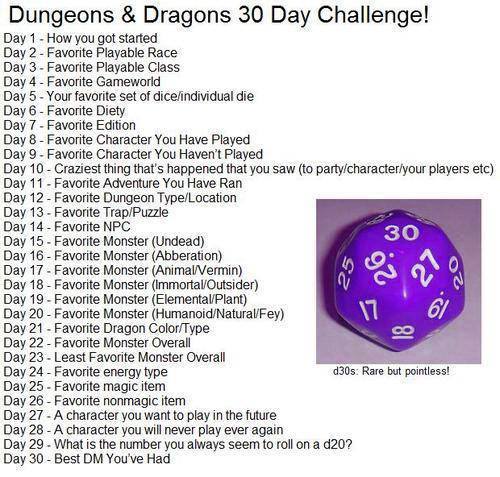
30 Day D&D - Favorite Monster (Undead)
While I have always been fond of the undead as an enemy (I ran an 11-year campaign with the undead as the main enemy), the Lich is the one with the most versatility. Most undead are fairly mindless and can, at times, be uninteresting. The lich is an undead that still retains it's intelligence and cunning. They can serve as a single encounter or be the masterminds behind an entire campaign. Their challenge level also ranges from the baseline to almost god-like with the added abilities of magic and items.
September 14, 2013
30 Day D&D - Favorite NPC
Abner. He was from my home-brew world. He was a gold dragon that often appeared in human form (and Abner was his human-form name). He was often a guide and mentor for the player characters. In my world the main threat was Zermarx, a mighty necromancer under Orcus who was waging a war against the PCs kingdom after they released him. It was Abner who had imprisoned him after the last war and then built up defenses in anticipation of Zermarx's inevitable return. Abner was a fumbling wizard prone to having his spells go astray, such as the occasional fireball that would land in the middle of the party.
If any of Abner characteristics sounds at all familiar it is because I blatantly stole the ideas from Dragonlance and Fizban the Fabulous. My players had not read the books so I was free to pillage ideas and I liked the concept of a bumbling mage that was a random element with the party.
As time wound on Abner slowly changed from a bumbler to a competent quest director. However, he is my favorite D&D NPC because...
A) He was fun to play as I tried to come up with some outrageous antics he could perpetrate.
B) The players had fun interacting with him.
C) He was an excellent quest guide.
However, he is not my favorite NPC of all time, as that belongs to Hugo, from my Feng Shui game. Hugo is a demon conjured by the Eaters of the Lotus that the player characters befriended. But that is a post for another day.
If any of Abner characteristics sounds at all familiar it is because I blatantly stole the ideas from Dragonlance and Fizban the Fabulous. My players had not read the books so I was free to pillage ideas and I liked the concept of a bumbling mage that was a random element with the party.
As time wound on Abner slowly changed from a bumbler to a competent quest director. However, he is my favorite D&D NPC because...
A) He was fun to play as I tried to come up with some outrageous antics he could perpetrate.
B) The players had fun interacting with him.
C) He was an excellent quest guide.
However, he is not my favorite NPC of all time, as that belongs to Hugo, from my Feng Shui game. Hugo is a demon conjured by the Eaters of the Lotus that the player characters befriended. But that is a post for another day.
September 13, 2013
30 Day D&D - Favorite Trap/Puzzle
When it comes to puzzles, for me there has to be the "ah, of course that is the answer" moment. If after the answer to a puzzle is revealed the players are still confused, then the puzzle has failed. Likewise with traps, there has to be the moment of "we could have avoided that trap".
Puzzles need to feel a part of whatever complex they are in. Puzzles randomly strewn around a dungeon does not make sense. There has to be a logical reason why a puzzle is where it is. Fortunately there are plenty of good reasons (excuses) for puzzles to be in a dungeon (hmmm this gives me an idea for a future blog article). Likewise, traps need to be a logical part of a dungeon. One basic underlying question for both traps and puzzles is - how do the beings that live there get around them? If a trap is a set of razor sharp blades that slice anything that walks down the hallway...how do the creatures that live there get down that hallway?
Through the years I have used many puzzles and traps. However, my favorites are always the ones that play off of the foibles of the players - the ones that make the players reassess their "standard operating procedure". Also, sometimes the most simple traps are the most diabolical.
The trap I use the most (and by default is my favorite) is the Double Pit Trap. The "normal" adventuring group will often find a trap in a hallway fairly easily. After finding the first one they then jump over it or pole-vault with their 10' pole if the trap is sprung by them or they walk over it with confidence if they disabled it. And then the second pit trap is directly after the first one. They invariably fall for the second trap every time.
Puzzles need to feel a part of whatever complex they are in. Puzzles randomly strewn around a dungeon does not make sense. There has to be a logical reason why a puzzle is where it is. Fortunately there are plenty of good reasons (excuses) for puzzles to be in a dungeon (hmmm this gives me an idea for a future blog article). Likewise, traps need to be a logical part of a dungeon. One basic underlying question for both traps and puzzles is - how do the beings that live there get around them? If a trap is a set of razor sharp blades that slice anything that walks down the hallway...how do the creatures that live there get down that hallway?
Through the years I have used many puzzles and traps. However, my favorites are always the ones that play off of the foibles of the players - the ones that make the players reassess their "standard operating procedure". Also, sometimes the most simple traps are the most diabolical.
The trap I use the most (and by default is my favorite) is the Double Pit Trap. The "normal" adventuring group will often find a trap in a hallway fairly easily. After finding the first one they then jump over it or pole-vault with their 10' pole if the trap is sprung by them or they walk over it with confidence if they disabled it. And then the second pit trap is directly after the first one. They invariably fall for the second trap every time.
September 12, 2013
30 Day D&D - Favorite Dungeon Type/Location
Wizard Towers.
The Wizard Tower is an iconic adventure location. It is my favorite because it allows the most variety when it comes to adventure design. When I am designing an adventure for my groups, I want to keep throwing new things at them. Kicking in doors, killing orcs and taking their treasure is fun, and I certainly make sure to include those sorts of things, but I also like to include puzzles, traps and different sorts of challenges. A Wizard Tower allows me to break the "normal" rules of dungeon design and throw oddball or the unexpected into the mix.
Everything can be explained with "it's magic" no matter how unusual it is. If I want an impassable wall that can only be bypassed by solving an intelligence puzzle, it is impassable because of magic. If I want an 8-headed Hydra to appear out of a small orb that falls to the ground and breaks after the players fail to correctly navigate a trap, it works because of magic. The magic of the Wizard allows me to do just about anything. I can present my players with a wide variety of challenges while still retaining some level of plausibility.
The Wizard Tower is an iconic adventure location. It is my favorite because it allows the most variety when it comes to adventure design. When I am designing an adventure for my groups, I want to keep throwing new things at them. Kicking in doors, killing orcs and taking their treasure is fun, and I certainly make sure to include those sorts of things, but I also like to include puzzles, traps and different sorts of challenges. A Wizard Tower allows me to break the "normal" rules of dungeon design and throw oddball or the unexpected into the mix.
Everything can be explained with "it's magic" no matter how unusual it is. If I want an impassable wall that can only be bypassed by solving an intelligence puzzle, it is impassable because of magic. If I want an 8-headed Hydra to appear out of a small orb that falls to the ground and breaks after the players fail to correctly navigate a trap, it works because of magic. The magic of the Wizard allows me to do just about anything. I can present my players with a wide variety of challenges while still retaining some level of plausibility.
September 11, 2013
30 Day D&D - Favorite Adventure You Have Ran
For those who do not know, this book included a broad mix of setting and adventures. The setting featured a valley complete with villages, towns and other locations players could make into their bases of operations - and also locations that needed protection. Spread around this valley were various dungeons and other adventuring locations waiting to be explored, including a complete system of underground passages that ran the length of the valley. Along with standard dungeon fare there were personalities to interact with and puzzles to challenge the players.
Vault of Larin Karr was a large sandbox ripe for a long campaign. While there was an over-arching threat there was no singular way to go about keeping the valley safe from the machinations of evil. It was an excellent setting waiting to be explored.
I really enjoyed running the setting/adventures. It allowed me to entertain my players with a wide range of different styles of play (rping, puzzles, dungeon crawls) without me having to do all the preliminary work (other than reading the material). I would certainly recommend it for any D&D system.
Side Note: My second favorite is The Lost City of Gaxmoor, a 3E Troll Lord Games sandbox adventure. It was also a lot of wild fun and definitely evoked my old-school sensibilities.
Subscribe to:
Posts (Atom)